

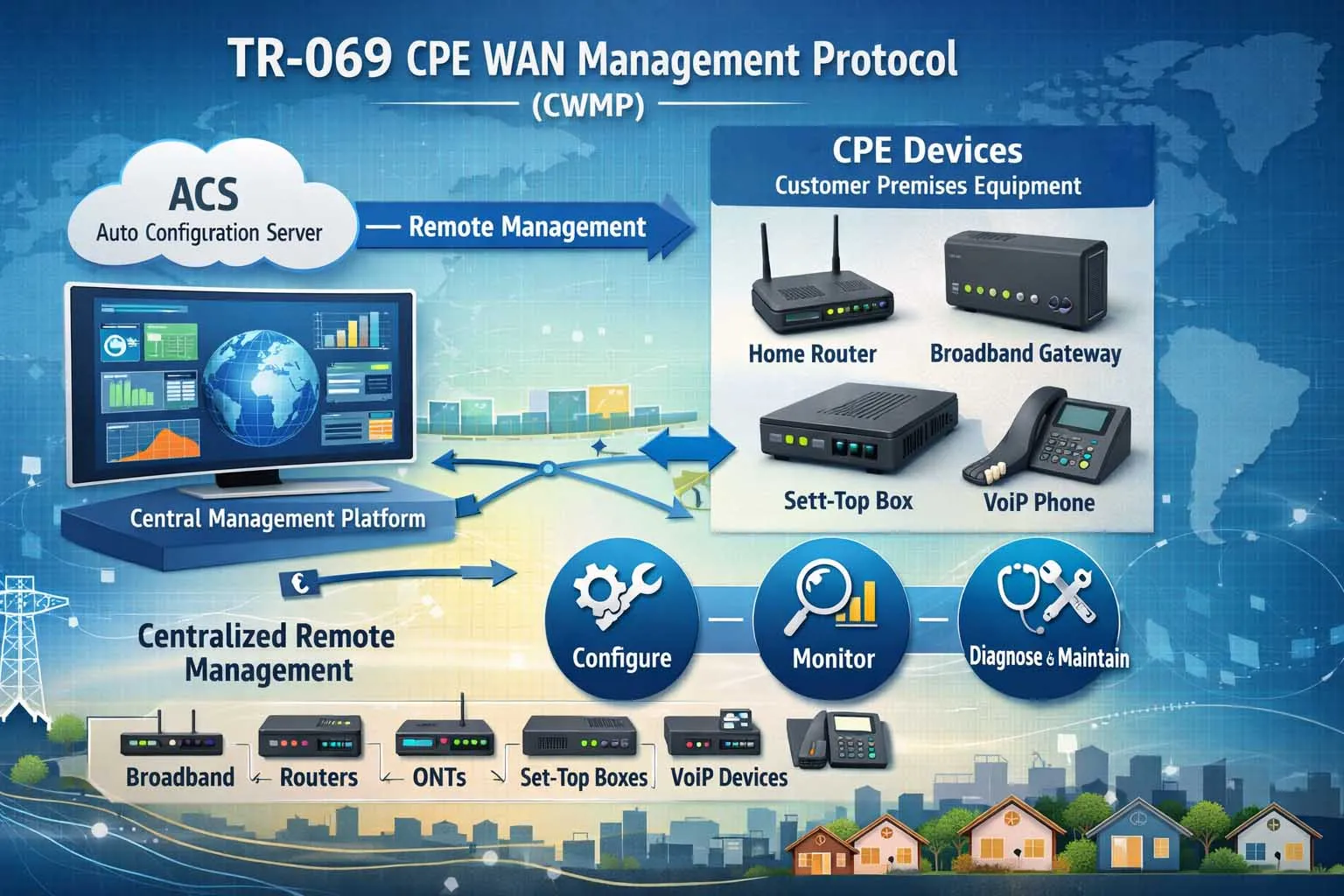
TR-069 is a Broadband Forum specification for remote device management. Its formal name is the CPE WAN Management Protocol, or CWMP, and it was created to let service providers and operators remotely provision, monitor, diagnose, and maintain customer-premises equipment from a centralized management platform. In practical deployments, TR-069 has long been used to manage broadband gateways, home routers, ONTs, modems, set-top boxes, VoIP devices, and other connected endpoints without requiring technicians to touch each device locally.
The value of TR-069 is not only that it enables remote access. Its real importance is that it provides a structured operational framework for device lifecycle management. Instead of treating each field device as an isolated product, operators can bring thousands or even millions of devices into a common management model. This allows more consistent onboarding, faster service activation, controlled firmware handling, better diagnostics, and more efficient support workflows across large networks.
Understanding TR-069
What TR-069 Means
TR-069 describes communication between a managed device and an Auto-Configuration Server, usually called an ACS. The device is often referred to as CPE, meaning customer-premises equipment. Under this model, the device and the ACS exchange management messages so that the server can learn device status, apply configuration, trigger downloads, launch diagnostics, and receive event notifications in a standardized way.
Because of this structure, TR-069 became one of the most important remote management frameworks in broadband access and managed device operations. It helped service providers reduce manual provisioning effort while improving consistency across diverse device fleets. For engineering teams, it also created a clearer boundary between field hardware and centralized operational control.
Why TR-069 Was Widely Adopted
TR-069 was adopted widely because broadband and managed service environments needed a practical method to operate growing numbers of remote devices. As networks expanded, manual configuration became inefficient, error-prone, and expensive. A common management protocol made it easier to activate services, push settings, collect diagnostics, and support customers at scale.
Another reason for its long life is interoperability. Devices from different vendors could expose standardized management objects and communicate with an ACS in a known format. While vendor-specific extensions still exist, the core framework gave operators a shared operational language for remote device control. That interoperability remains one of the reasons TR-069 still appears in many real deployments today.

How TR-069 Works
The ACS and CPE Relationship
At the center of TR-069 is the relationship between the ACS and the managed device. The ACS is the centralized server-side platform that stores policies, configuration logic, device records, operational workflows, and service parameters. The CPE is the endpoint being managed, such as a residential gateway, modem, router, or optical network terminal installed at the subscriber side.
In a typical workflow, the device initiates communication to the ACS and establishes a management session. During that session, the device can report identifying information, software details, parameter values, and event states. The ACS can then respond with instructions, including reading or writing parameters, scheduling actions, triggering downloads, or requesting diagnostic operations. This controlled exchange is what turns TR-069 from a simple monitoring mechanism into a full lifecycle management protocol.
Sessions, Events, and Device-Initiated Contact
One of the important design choices in TR-069 is that the device generally initiates the connection toward the ACS. This helps when the device is located behind NAT, in a home environment, or in a managed access network where inbound reachability may be limited. Once the session is active, the ACS can perform management tasks within that exchange.
TR-069 also uses event-driven logic. Devices can send Informs to report meaningful conditions such as initial boot, periodic contact, configuration change, transfer completion, or diagnostics completion. This makes the protocol more operationally useful than a simple one-way configuration push. The ACS does not only send instructions; it also learns what happened on the device and when it happened.
In many deployments, this event model helps support teams understand whether a device has just come online, completed a firmware transfer, finished a troubleshooting test, or changed a monitored parameter. That time-based awareness is one of the reasons TR-069 became closely tied to large-scale broadband operations.
SOAP Messaging and Transport
TR-069 uses SOAP-based remote procedure calls carried over HTTP, and secure deployments can use HTTPS with TLS. This protocol stack reflects the era in which TR-069 matured, but it also explains why the system is highly structured. Commands, responses, events, and faults are exchanged in defined message formats rather than through ad hoc scripts or vendor-specific remote interfaces.
Although SOAP can feel heavyweight compared with newer API styles, it brought predictability and extensibility to operator environments that required clear procedural behavior. That predictability still matters in installed networks where reliability, repeatable workflows, and broad vendor compatibility are more important than adopting the newest management interface style.
TR-069 is best understood as an operational control framework for remote devices, not just a protocol for reading status. Its real strength is coordinated device lifecycle management at scale.
Core Features of TR-069
Remote Provisioning and Configuration Management
The most recognized feature of TR-069 is remote provisioning. An operator can use an ACS to assign service parameters, update settings, configure WAN behavior, define voice service values, adjust Wi-Fi settings, or modify device-specific options without sending a technician on site. This is especially valuable when a network contains a large installed base of customer devices spread across many regions.
Configuration management through TR-069 is important not just for initial deployment, but also for ongoing service consistency. Operators can standardize templates, apply changes in a controlled sequence, and reduce errors that come from manual local configuration. In a managed broadband business, that operational consistency directly affects activation speed, support quality, and subscriber experience.
Monitoring, Notifications, and Operational Visibility
TR-069 also supports device monitoring and status visibility. A managed device can expose parameters that describe software version, network interface state, performance indicators, connection status, service configuration, and many other operational details. The ACS can read these values to understand current device condition and service posture.
Beyond polling-like parameter retrieval, TR-069 includes notification concepts and event reporting. Devices can actively inform the ACS when relevant changes occur, which helps shorten the gap between an operational event and a management response. This is useful in support environments where knowing that a reboot, parameter change, or diagnostics completion has occurred is just as important as knowing the current configuration.
Diagnostics, File Transfer, and Firmware Handling
Another major feature area is remote maintenance. TR-069 supports diagnostic functions and can coordinate operations such as testing, reporting completion events, and retrieving results. This allows operators to troubleshoot service issues from a centralized platform rather than depending entirely on field intervention.
The protocol also supports managed file transfer workflows, including downloads and related completion reporting. In real deployments, this capability is commonly associated with firmware upgrades, configuration file delivery, or other controlled content distribution tasks. That makes TR-069 especially useful for lifecycle maintenance, because it allows a service provider to improve, repair, or standardize device behavior after installation rather than treating deployment as a one-time event.
When used well, firmware and file management through TR-069 can support planned upgrades, phased rollout strategies, and fault recovery processes. This is one of the reasons the protocol remains operationally significant in large installed environments even as network architectures continue to evolve.

TR-069 Network Architecture
Main Architectural Components
A TR-069 deployment usually includes four practical layers: the field device, the access network, the ACS platform, and the operator's backend systems. The field device is the CPE that the operator wants to manage. The access network provides IP connectivity between the device and the management environment. The ACS handles the protocol sessions and management logic. Backend systems may include OSS, BSS, inventory databases, analytics platforms, customer care tools, and provisioning engines that interact with the ACS.
This layered architecture matters because TR-069 rarely works in isolation. In real operator environments, the ACS often sits inside a wider service management ecosystem. It may receive policy inputs from provisioning systems, expose device state to support platforms, coordinate with firmware repositories, and feed operational data to reporting tools. That wider context is why TR-069 should be seen as a management architecture component rather than a standalone protocol feature.
Data Models and Managed Parameters
TR-069 depends heavily on data models because the ACS needs a structured way to know what a device can expose and what parameters can be read or changed. Broadband Forum data models such as TR-181 became especially important for this purpose because they describe device information, interfaces, diagnostics, software and firmware elements, routing behavior, and many other manageable functions in a standardized structure.
In practice, this means the ACS can work with named objects and parameters instead of only using vendor-unique custom commands. Standard data models improve interoperability, while vendor extensions allow deeper control of specialized features. The balance between standard objects and vendor-specific extensions is one of the defining characteristics of mature TR-069 deployments.
For operators, the data model layer is what makes large-scale automation possible. The ACS is not just connected to a device; it understands the manageable structure of that device. That understanding is what enables repeatable provisioning logic across device families.
Connection Requests and Remote Reachability
Although the device generally initiates sessions, TR-069 also includes mechanisms for the ACS to request renewed contact from the device. This is commonly described as a connection request. In operational terms, it allows the ACS to ask the device to establish a new management session so that pending actions can be executed without waiting for the next periodic contact window.
This design is useful because many managed devices sit behind home gateways, broadband edge policies, or addressing conditions that make direct inbound management difficult. TR-069 works around this challenge by keeping the device responsible for originating the management session while still allowing the ACS to influence when that session occurs. That makes the protocol practical for large-scale consumer and broadband environments where direct device exposure would be undesirable or impossible.
The architecture of TR-069 is one of its biggest strengths: the device stays remotely manageable even when it is not directly reachable like a traditional server on the open network.
Benefits of TR-069 in Real Operations
Lower Field Service Costs and Faster Activation
One of the clearest benefits of TR-069 is that it reduces the need for manual field operations. Devices can be provisioned remotely, service parameters can be corrected centrally, and common changes can be rolled out without dispatching personnel to each location. For broadband providers and managed service operators, that has a direct effect on operational cost.
It also shortens service activation time. A newly deployed device can contact the ACS, identify itself, receive the appropriate settings, and move into service with less manual intervention. In high-volume environments, this kind of automation significantly improves deployment efficiency and reduces the chance of inconsistent setup between sites or subscribers.
Improved Support and Better Lifecycle Control
TR-069 improves support quality because it gives service teams better visibility into device state, software level, parameter configuration, and recent events. Support engineers do not have to rely only on customer descriptions of a problem. They can inspect data, verify settings, and, in many cases, trigger diagnostics or corrective changes from the ACS.
It also improves lifecycle control. Operators can plan firmware strategies, maintain standard device behavior, manage configuration drift, and coordinate service evolution over time. Instead of regarding each installed endpoint as fixed after deployment, TR-069 makes it possible to treat the entire fleet as an actively managed operational asset.
Common Applications of TR-069
Broadband Routers, Gateways, and ONTs
The most common TR-069 application is remote management of broadband subscriber devices. Home gateways, DSL or cable gateways, fiber ONTs, Wi-Fi routers, and integrated access devices can all be managed through an ACS using TR-069-compatible workflows. In these scenarios, the protocol helps service providers onboard devices, apply service settings, collect diagnostics, and maintain software consistency across large user populations.
This is the classic environment in which TR-069 became established. The device is installed at the subscriber edge, but the operational control remains centralized. That combination is one of the protocol's defining practical strengths.
VoIP, IPTV, and Multi-Service Customer Equipment
TR-069 is also used where the managed device supports more than basic internet access. VoIP gateways, set-top boxes, voice-capable residential gateways, and integrated multi-service CPE can all benefit from remote provisioning and monitoring. In these cases, the ACS may coordinate multiple service layers on a single device, such as WAN connectivity, Wi-Fi behavior, voice parameters, and service-specific diagnostics.
This multi-service capability is operationally important because it lets providers treat the subscriber device as a service platform rather than only as a transport endpoint. The more services depend on the device, the more valuable structured remote management becomes.
Managed Enterprise Edge and Specialized Access Devices
Although TR-069 is most strongly associated with residential broadband, it can also appear in managed enterprise edge devices, branch access gateways, and specialized operator-supplied network appliances. Any environment that benefits from centralized provisioning, software control, and remote diagnostics can potentially use the same management principles, especially when the device is operator-managed and deployed in volume.
In these use cases, the main advantage is not consumer scale but operational uniformity. A provider or managed service organization can maintain consistent service behavior across many remote endpoints while keeping local intervention to a minimum.

TR-069 and Modern Device Management
Why TR-069 Still Appears in Current Networks
TR-069 remains relevant because network reality changes more slowly than product marketing. Large installed bases of devices still support CWMP, operator workflows have been built around ACS logic for years, and many field environments value proven operational methods over disruptive change. As a result, TR-069 continues to appear in broadband and managed device networks even where newer management approaches are being introduced.
Its continuing value comes from mature tooling, operational familiarity, and the scale of existing deployments. In many organizations, the question is not whether TR-069 exists, but how to maintain, optimize, or gradually evolve beyond it without disrupting active services.
How It Fits into Transition Strategies
In modernization projects, TR-069 is often part of a transition architecture rather than an endpoint. Operators may keep TR-069 for existing device populations while evaluating newer device management frameworks for future platforms. This staged approach reduces migration risk because it avoids forcing every device family into a new operational model at the same time.
That is why understanding TR-069 still matters. Even when the long-term direction points toward newer standards and cloud-native management approaches, teams still need to design around what is deployed today. A realistic migration plan begins with a solid understanding of the installed management framework, and in many broadband environments that framework is still TR-069.
TR-069 is not only a legacy topic. It is often the starting point for understanding how large-scale remote device management evolved and how many active networks are still operated today.
Conclusion
Why TR-069 Matters
TR-069 is a remote device management framework that allows an ACS to provision, monitor, diagnose, and maintain customer-premises equipment through structured CWMP sessions. Its operational importance comes from its ability to standardize device lifecycle management across large and diverse fleets of broadband and access devices.
For service providers, system integrators, and network operations teams, TR-069 remains important because it connects remote field equipment with centralized operational control. Whether the goal is faster service activation, better firmware management, improved diagnostics, or lower support cost, TR-069 has played a major role in making large-scale remote device operations practical and manageable.
FAQ
Is TR-069 the same as CWMP?
TR-069 is the Broadband Forum technical report, while CWMP is the formal protocol name defined by that specification. In everyday engineering language, people often use the two terms almost interchangeably because TR-069 is the document that defines the CPE WAN Management Protocol.
In practical discussions, saying that a device supports TR-069 usually means that it supports CWMP-based remote management with an ACS. The distinction is mainly formal rather than operational.
What devices are commonly managed with TR-069?
Common examples include broadband routers, home gateways, optical network terminals, DSL or cable gateways, integrated Wi-Fi devices, set-top boxes, and VoIP-capable customer equipment. The protocol is especially common where an operator deploys and manages large numbers of endpoint devices in the field.
It can also appear in managed enterprise edge equipment or specialized access devices where centralized provisioning and diagnostics are important. The deciding factor is usually not device category alone, but whether the operator needs structured remote lifecycle control.
Does TR-069 only configure devices, or can it also monitor them?
TR-069 supports much more than initial configuration. It can be used to read parameter values, collect status information, receive event notifications, trigger diagnostics, and coordinate firmware or file transfer operations. In that sense, it combines provisioning and operational maintenance in one management framework.
This broader scope is why TR-069 became so valuable in service provider environments. It helps operators not only turn devices on with the right settings, but also keep them running and troubleshoot them over time.
Why is the ACS important in a TR-069 deployment?
The ACS is the control point that stores management logic, device records, policy rules, and provisioning workflows. Without the ACS, the protocol does not deliver its real operational value because the device would have no central platform to report to or receive instructions from.
In large deployments, the ACS becomes the operational brain of the remote device fleet. It connects device behavior with backend systems, support processes, and service activation workflows.
Is TR-069 still relevant if newer standards exist?
Yes. Many active networks still rely on TR-069 because of large installed device populations, mature operational processes, and the practical difficulty of immediate migration. Even when newer frameworks are being evaluated, TR-069 often remains part of the real operating environment for years.
That is why engineers and operators still need to understand it. In many cases, successful modernization depends on knowing how existing TR-069-based device management works before planning the next step.